Brake Fluid Flush Service: Why It Matters More Than Most People Think
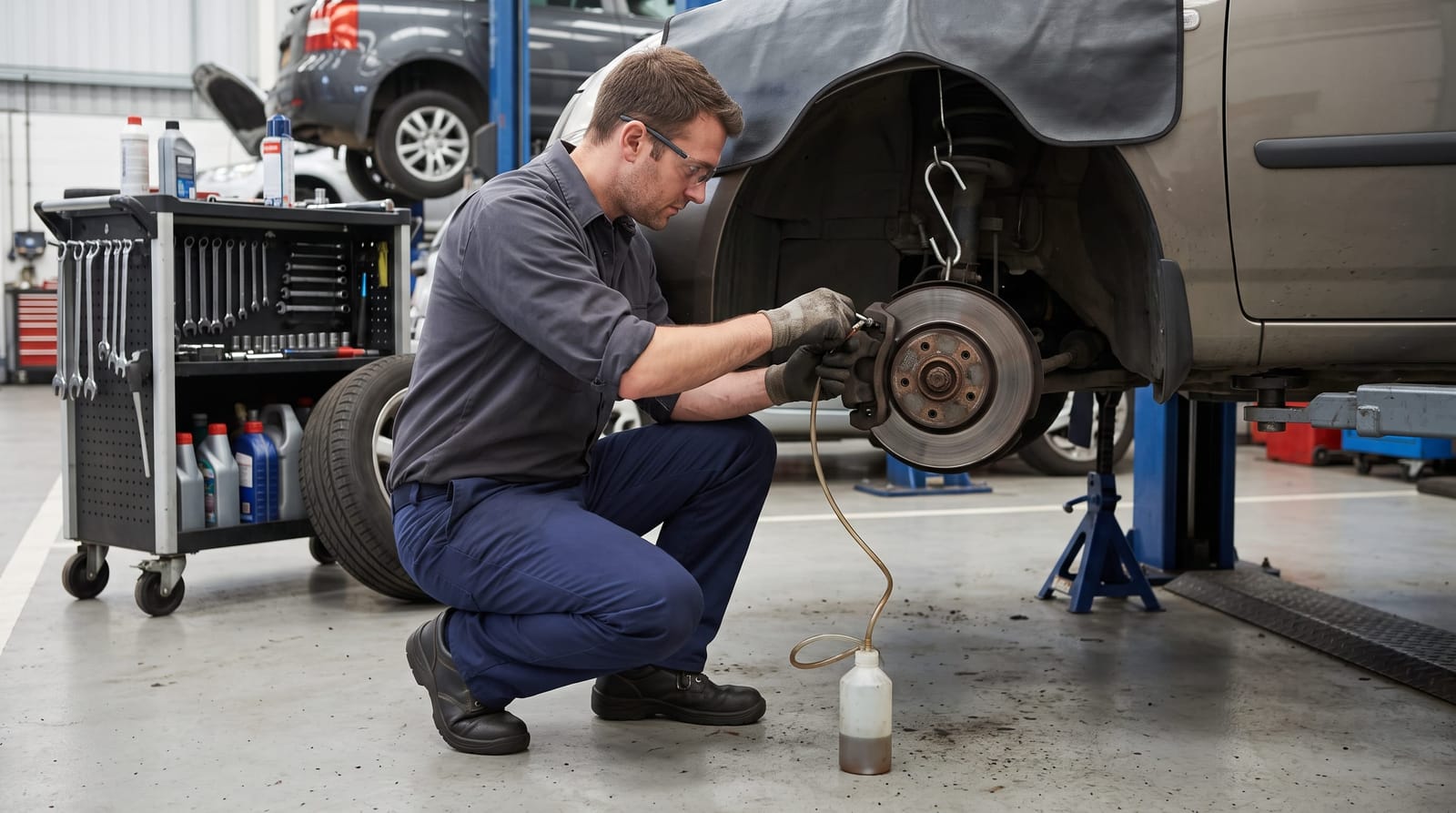
When most vehicle owners think about brake maintenance, they picture worn pads or scored rotors: the parts you can hear and feel when something goes wrong. But there's a quieter, less visible component doing critical work every time you press that pedal: brake fluid. As part of understanding complete brake service and repair, the brake fluid flush is one of the most overlooked services on any maintenance schedule, yet one of the most consequential, especially for drivers navigating Colorado's demanding mountain roads and towing conditions. If you're searching for a reliable brake fluid flush service in Fort Lupton, CO, this guide will walk you through exactly why this service exists, when you need it, and what happens when it gets skipped.
What Brake Fluid Actually Does in a Hydraulic Braking System
To understand why a flush matters, you first need to understand what brake fluid is doing inside your vehicle every time you slow down. Your braking system is hydraulic: meaning it uses liquid under pressure to transmit force from your foot on the pedal to the calipers or wheel cylinders that squeeze your brake pads against the rotors.
When you press the brake pedal, you compress a piston inside the master cylinder. That pressure travels through a closed network of brake lines, hoses, and fittings, all filled with brake fluid, to apply clamping force at each wheel simultaneously. The fluid doesn't get consumed the way oil does, but it does degrade. And that degradation has serious consequences.
The Types of Brake Fluid and Why They Matter
Most passenger vehicles and light trucks use DOT 3, DOT 4, or DOT 5.1 brake fluid. These are glycol-ether-based fluids rated by their dry and wet boiling points: the temperatures at which the fluid boils when fresh versus after absorbing moisture. The higher the boiling point, the more heat the fluid can withstand before it begins to fail. DOT 4 and DOT 5.1 fluids have higher boiling points and are commonly specified for performance vehicles or heavy towing applications.
Your owner's manual will specify which type your vehicle requires. Using the wrong type, or mixing incompatible fluids, can compromise seals and reduce braking performance. A qualified technician will verify the correct fluid specification before performing any flush service.
How Moisture Absorption Degrades Brake Fluid Over Time
Here's the property of brake fluid that most people don't know: it is hygroscopic, meaning it actively absorbs moisture from the surrounding environment. Water enters the brake system through microscopic permeation of rubber hoses, through the master cylinder reservoir cap, and through normal condensation over time. This isn't a flaw in design: it's an intentional property that keeps absorbed water distributed throughout the fluid rather than pooling in one location where it could cause immediate corrosion.
The problem is cumulative. As water content increases, even by just 3 to 4 percent, the boiling point of the fluid drops dramatically. Fresh DOT 3 fluid may boil at around 400°F. The same fluid with significant moisture absorption can boil well below 300°F. That range difference may sound abstract until you're pressing your brakes hard on a long mountain descent with your trailer behind you.
What Happens When Brake Fluid Boils
When brake fluid reaches its boiling point during heavy braking, it converts to a gas inside the brake lines. Unlike liquid, gas is compressible. The result is a sudden, terrifying loss of pedal resistance: the pedal sinks toward the floor with little or no braking response. This phenomenon is called vapor lock, and it can occur in situations where brakes are applied repeatedly and heat builds in the system: mountain passes, long grades, stop-and-go hauling, or emergency braking.
The Corrosion Problem
Beyond vapor lock, moisture in the brake fluid accelerates corrosion throughout the hydraulic system. Calipers, wheel cylinders, ABS modulators, and metal brake lines are all vulnerable. Corrosion inside calipers can cause pistons to seize, leading to uneven braking, pad wear, and eventual caliper failure: repairs that cost significantly more than a routine fluid flush.
When to Schedule a Brake Fluid Flush Service in Fort Lupton, CO
There's no single universal interval because fluid degradation depends on driving style, vehicle type, climate, and the specific fluid used. However, there are widely accepted general guidelines worth understanding. Always consult your vehicle's owner's manual and a qualified technician for recommendations specific to your make, model, and driving conditions.
Time-Based Guidelines
Many vehicle manufacturers and automotive professionals suggest evaluating brake fluid condition every two years, regardless of mileage. In humid environments or during Colorado winters, where temperature swings and moisture exposure are significant, more frequent evaluation may be appropriate. A technician can test moisture content in your current fluid using a simple test strip or electronic tester to give you an objective reading rather than relying on calendar intervals alone.
Mileage-Based Guidelines
General mileage guidance commonly cited in automotive service contexts ranges from 30,000 to 45,000 miles for a full brake fluid flush, though this varies by manufacturer recommendation. High-mileage drivers who rack up 20,000 miles annually may need more frequent attention than drivers who put on 8,000 miles per year. Again, your vehicle's documentation and a trusted local technician are your best resources for personalized guidance.
Condition-Based Triggers
Certain situations warrant an immediate fluid inspection rather than waiting for a scheduled interval:
- Brake fluid that appears dark, cloudy, or discolored (fresh fluid is typically clear to light amber)
- A soft, spongy, or low brake pedal with no obvious leak
- After any major brake component repair (calipers, master cylinder, brake lines)
- Before or after extended towing trips through mountain terrain
- When purchasing a used vehicle with no documented service history
Why Colorado Mountain Driving and Towing Make This Service Critical
For drivers in Fort Lupton and across Weld County, brake fluid maintenance carries added urgency. Colorado's geography creates braking demands that flatland drivers simply don't face. The I-25 corridor, mountain access roads, and routes toward Estes Park or Rocky Mountain National Park involve sustained downhill grades where brakes are applied repeatedly over extended periods. Each application generates heat that accumulates in the system.
For towing vehicles, pickup trucks hauling heavy equipment, trailers, or recreational vehicles, the thermal load on the braking system increases dramatically. A loaded trailer doesn't just add weight; it adds momentum that the braking system must absorb and dissipate as heat on every downhill run. Drivers who regularly tow with diesel pickups and work trucks understand that their brake systems face conditions far beyond normal commuter use.
For those operating truck brake service Weld County CO: the demands on brake fluid are heightened compared to standard passenger vehicles. Degraded fluid in a tow vehicle headed down a steep Colorado grade is not an abstract risk: it's a scenario where the difference between fresh and contaminated fluid can become a genuine safety concern. This is educational context, not advice; always work with a qualified technician to evaluate your specific vehicle and use case.
Altitude and Temperature Swings
Colorado's altitude also plays a role. At higher elevations, fluids can behave differently, and temperature swings between warm afternoons and cold mountain nights create condensation cycles that accelerate moisture accumulation in brake systems. Vehicles that travel regularly between Fort Lupton's plains elevation and higher mountain destinations may experience faster fluid degradation than those that stay at consistent altitudes.
What a Professional Brake Fluid Flush Service Involves
A brake fluid flush is not the same as a brake fluid top-off. Topping off adds fresh fluid to the reservoir without removing the old, moisture-saturated fluid from the lines, calipers, and wheel cylinders. A proper flush replaces the entire volume of fluid in the hydraulic system.
The Flush Process
During a professional brake fluid flush, a technician will typically:
- Test the existing fluid for moisture content and condition
- Remove old fluid from the master cylinder reservoir
- Introduce fresh fluid and systematically bleed the system at each wheel, starting with the wheel farthest from the master cylinder, until old fluid is fully evacuated
- Inspect brake lines, hoses, and fittings for signs of corrosion, cracking, or leaks during the process
- Verify correct fluid type and fill level before returning the vehicle
Shops in Fort Lupton offering brake fluid flush services include R & L Tires at 816 4th St, Grease Monkey on Dexter St, and Instant Car Fix for mobile service. Each of these providers performs fluid exchanges as part of broader brake and vehicle maintenance services.
What It Won't Fix
A fluid flush addresses fluid condition: it won't correct worn brake pads, warped rotors, or seized calipers. If you're experiencing noticeable symptoms like squealing, grinding, pulling, or a pulsating pedal, those issues require inspection of the brake hardware as well. Understanding brake pad rotor replacement Brighton CO can help you recognize when a flush alone isn't the complete solution.
The Cost of Skipping It: Real Consequences of Neglected Brake Fluid
From a purely mechanical standpoint, the consequences of ignoring brake fluid maintenance compound over time. What begins as moisture absorption becomes corrosion. Corrosion leads to seized caliper pistons, which cause uneven pad wear and dragging brakes. Dragging brakes generate excess heat, which further degrades already compromised fluid. It becomes a reinforcing cycle that ultimately means more expensive repairs than a periodic flush would have cost.
ABS systems are particularly vulnerable. The modulators and solenoids in anti-lock braking systems have tight tolerances that corroded, contaminated fluid can damage. ABS component replacement is significantly more expensive than most other brake system repairs.
Beyond mechanical costs, there's the broader context of braking performance. Brake fluid is one component within a complete brake system: understanding the full picture of brake maintenance is why resources like the brake service and repair guide for Fort Lupton, CO address fluid, pads, rotors, and hardware as an integrated system rather than isolated parts.
Related Brake Service Topics Worth Exploring
Brake fluid health connects directly to other aspects of your brake system's performance and longevity. Topics that expand on this foundation include:
- Brake line inspection and replacement: Corroded brake lines are a direct consequence of moisture-contaminated fluid over time, and they represent one of the more serious hydraulic system failures.
- Caliper service and replacement: Seized caliper pistons, often caused by internal corrosion accelerated by degraded fluid, affect braking balance and accelerate rotor and pad wear.
- ABS system diagnostics: Contaminated fluid is a common contributor to ABS warning lights and modulator failures, particularly in older high-mileage vehicles.
Final Thoughts: Don't Let Brake Fluid Be the Last Thing You Check
Brake fluid flush service is one of those maintenance items that's easy to defer because nothing obviously breaks when you skip it, at first. But for drivers in Fort Lupton and surrounding Weld County communities who face mountain grades, variable weather, and the demands of towing season, degraded brake fluid is a hidden liability. A periodic fluid evaluation is straightforward, relatively affordable, and far less disruptive than dealing with the component failures that neglected fluid eventually causes.
If you can't remember the last time your brake fluid was inspected or replaced, or if you're preparing for a season of hauling, schedule a brake fluid flush service in Fort Lupton, CO with a qualified local technician. It's a small investment with meaningful returns in both safety and long-term brake system health.