Heavy-Duty Truck Brakes: Brake Service for Diesel Pickups & Work Trucks in Weld County
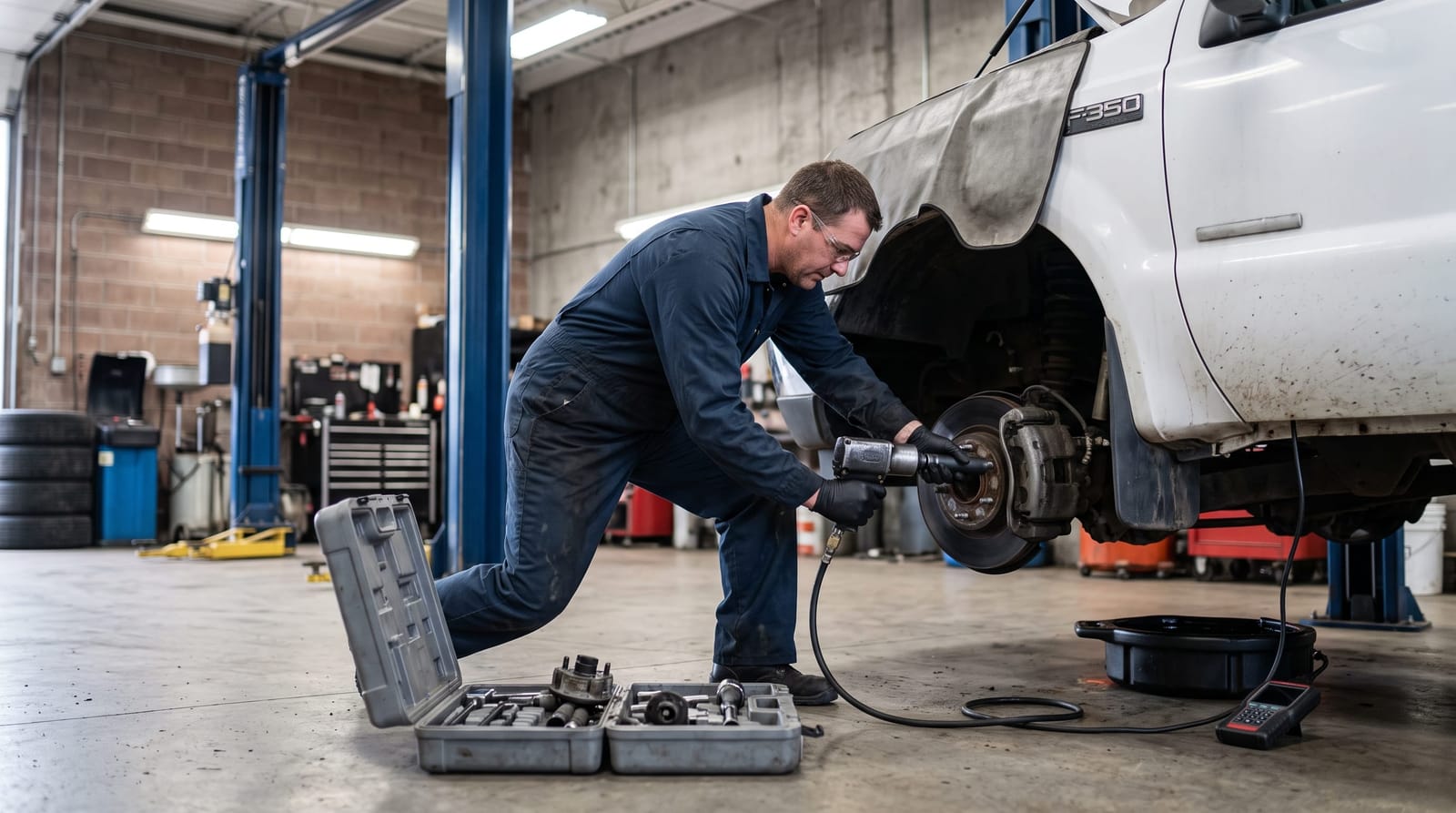
If you drive an F-250, Ram 2500, or Silverado 2500 in Weld County, your truck's brakes work harder than most people realize. Heavy payloads, trailer loads, and rough rural roads demand a brake system that can handle serious stress. This is a subtopic we cover in depth as part of our broader guide to brake service and repair in Fort Lupton, CO. In this post, we focus specifically on what makes truck brake service in Weld County, CO different from standard passenger car brake work, and why getting it right matters for your safety, your cargo, and everyone sharing the road with you. We'll cover rotor sizing, pad selection for towing, caliper maintenance, brake line integrity, and how to recognize when your truck's brakes need attention.
Why Heavy-Duty Truck Brakes Are a Different Animal
A half-ton pickup weighs roughly 4,500 to 5,500 pounds empty. A three-quarter-ton diesel truck like a Ford F-250 or Ram 2500 can tip the scales at 6,000 to 7,500 pounds before you add a single thing to the bed or hitch a trailer. Add a loaded gooseneck or a fifth-wheel camper, and your gross combined vehicle weight can easily exceed 20,000 pounds.
That weight creates stopping force demands that are simply in a different category from what a sedan or crossover faces. More mass means more kinetic energy. More kinetic energy means more heat generated at the rotors during braking. More heat means faster wear, and a higher risk of brake fade if the system isn't properly sized and maintained.
Larger Rotors and Greater Surface Area
Factory brake rotors on heavy-duty diesel trucks are significantly larger than those on light-duty vehicles. A Ram 2500's front rotors commonly measure 14 inches or more in diameter. That extra surface area is intentional. It spreads heat over a larger zone, which helps the rotor dissipate temperature faster and maintain consistent stopping power.
Despite that advantage, heavy-duty rotors still wear. They develop grooves, hot spots, and thickness variation over time, especially under repeated high-load braking. A rotor that measures below its minimum thickness specification should be replaced, not resurfaced. The minimum thickness rating exists for a reason: a thinner rotor holds less heat, warps more easily, and can crack under extreme stress.
Pad Compounds Designed for Load
Standard brake pads are formulated for average passenger vehicle weights and driving patterns. Heavy-duty trucks need pads with a compound that handles higher heat ranges. Ceramic and semi-metallic pads are common choices for diesel trucks. Semi-metallic pads generally offer better performance under sustained high-heat conditions, which is exactly what towing creates. The trade-off is slightly more rotor wear compared to ceramic. A technician with diesel truck experience can recommend the right compound for how you actually use your truck.
Towing and Braking: What Changes When You Pull a Trailer
Towing fundamentally changes how your brakes behave. When you're pulling a trailer that doesn't have its own braking system, or one whose trailer brakes aren't properly adjusted, your truck's brakes absorb all the stopping force for the entire combination. Studies from the National Highway Traffic Safety Administration have found that improperly maintained brakes are a contributing factor in roughly 22% of commercial vehicle crashes. While that figure covers commercial fleets, it underscores how critical brake condition is when you're moving heavy loads.
Brake Fade: The Silent Danger on Long Downhill Grades
Colorado's terrain adds a layer of complexity. Weld County sits near the Front Range, and many truck owners regularly travel into the mountains. Long descents on I-70 or on rural county roads put sustained thermal stress on brake components. Brake fade occurs when rotors and pads get so hot that friction efficiency drops sharply. The result is a pedal that feels mushy or requires significantly more pressure to achieve normal deceleration.
Brake fade isn't just uncomfortable: it's dangerous. Properly rated pads and rotors in good condition are your primary defense against it. So is correct trailer brake setup, but that's a separate system worth having inspected on its own.
Pad Life Under Towing Conditions
Brake pad life varies widely depending on how often and how heavily you tow. A truck used primarily for highway commuting might see front pad life of 50,000 miles or more. The same truck towing a 10,000-pound trailer through mountain grades might need new front pads in 25,000 miles or fewer. For a detailed breakdown of what affects pad longevity on diesel trucks, see our post on brake pad life for diesel towing trucks in Colorado.
Caliper Maintenance: The Component Most Truck Owners Overlook
Brake calipers squeeze the pads against the rotor to create friction. On heavy-duty trucks, the calipers are larger and more robust than on passenger cars. But they have the same vulnerabilities: seized pistons, torn dust boots, and corroded slide pins.
Seized Calipers and Uneven Wear
A caliper with a sticky or seized piston won't release fully after braking. This keeps the pad in constant light contact with the rotor. The result is accelerated pad wear on one side, rotor scoring, and heat buildup even when you're not actively braking. You may notice your truck pulling to one side under braking, or smell a burning odor after highway driving. Both are signs worth investigating promptly.
Slide Pin Lubrication
Caliper slide pins allow the caliper body to move in and out as pads wear. If those pins corrode or dry out, the caliper can't float properly. This is a common issue on trucks that see road salt, mud, or regular off-road use, all normal conditions in Weld County. Slide pin lubrication is a routine part of a quality brake service, but it's often skipped at shops that rush through jobs. Ask specifically whether slide pins are being cleaned and lubricated when you bring your truck in for brake work.
Brake Line Integrity: The Line Between Stopping and Not
Hydraulic brake lines carry pressurized brake fluid from your master cylinder to the calipers and wheel cylinders. On heavy-duty trucks, these lines face real-world punishment. Gravel impacts, flex from towing, and exposure to road chemicals all take a toll over time.
Rubber Flex Hoses
Each wheel typically has a short rubber flex hose that connects the rigid steel brake line to the caliper. These hoses allow movement as the suspension cycles. Over time, the inner lining of a flex hose can deteriorate and collapse partially. A collapsed hose creates a one-way valve effect. Brake pressure gets to the caliper but can't fully release. This mimics a seized caliper in terms of symptoms. Replacing aging flex hoses during a brake service is a smart precaution on any truck with high mileage or many years of service.
Steel Lines and Corrosion
Steel brake lines are vulnerable to corrosion from the inside out in areas where road salt is used. Many Weld County truck owners haul loads through multiple climate zones during the winter months. A small pinhole in a brake line can cause gradual fluid loss. A larger failure can result in sudden, significant loss of braking pressure. Inspecting brake lines for rust bubbling, dampness, or visible corrosion is part of any thorough brake inspection, and it's especially important on trucks over five years old with high mileage.
Common Warning Signs Diesel Truck Owners Should Know
Heavy-duty trucks don't always broadcast brake problems as obviously as passenger cars. The vehicles are heavier and stiffer. Some noises get absorbed by body insulation and undercoating. That makes proactive inspection more important than simply waiting for symptoms. With that said, here are the most common warning signs that your diesel truck's brakes need attention:
- Grinding or metal-on-metal noise: Pads worn through to the backing plate contacting the rotor directly. This causes rotor damage quickly and requires immediate attention.
- Vibration through the brake pedal: Typically indicates rotor thickness variation or warping. Common after repeated hard stops without adequate cool-down time.
- Truck pulling to one side when braking: Often a seized caliper or a collapsed flex hose on one side creating uneven braking force.
- Soft or spongy pedal: May indicate air in the brake lines or low brake fluid: check for leaks if you notice this.
- Burning smell after driving: Can signal a dragging caliper keeping pads in constant contact with the rotor.
- Longer stopping distances: A general warning that braking performance has degraded. Especially noticeable when towing.
As a general guideline, most diesel truck manufacturers recommend brake inspections every 12,000 to 15,000 miles, or at every oil change if your truck sees heavy towing or hauling. Refer to your owner's manual and consult a qualified technician for guidance specific to your vehicle.
Why Experience With Diesel Trucks Matters in a Brake Shop
Not every shop has hands-on experience with heavy-duty diesel platforms. The torque specs, component dimensions, and service procedures for an F-250 Super Duty are different from those for a standard F-150. Experienced technicians who regularly work on Ram 2500s, Silverado 2500s, and similar platforms understand these differences. They know which OEM-equivalent parts meet the demands of heavy-duty use. They know how to properly torque large caliper bolts and how to bleed brake systems on trucks with longer brake line runs.
At CTDS in Fort Lupton, truck brake service is a core part of what we do. We work on diesel pickups regularly, not occasionally. If you're in Weld County and searching for reliable truck brake service in Weld County, CO, our familiarity with these platforms translates directly into better, more accurate work on your vehicle.
For context on what brake service costs and when pad and rotor replacement typically makes sense in this region, see our related post on brake pad and rotor replacement near Brighton, CO. The pricing context and service timing guidance there applies equally to Weld County truck owners.
Related Details Worth Exploring
This post gives you a comprehensive overview of heavy-duty truck brake service. For more specific detail on individual topics within this area, explore these related resources:
- Brake pad life for diesel trucks used for towing in Colorado: A deeper look at how towing frequency, trailer weight, and terrain affect how quickly your pads wear down.
Keep Your Work Truck Stopping Safely: No Matter the Load
Your diesel pickup does serious work. Your brakes need to be equally serious about keeping up. From properly rated pads and oversized rotors to caliper condition and brake line integrity, every component of a heavy-duty truck's brake system plays a role in safe stopping, especially when you're hauling cargo or towing a trailer through Weld County's varied terrain.
CTDS in Fort Lupton provides truck brake service for diesel pickups and work trucks across Weld County. We have the experience and the equipment to service heavy-duty platforms correctly. If your F-250, Ram 2500, or Silverado 2500 is due for a brake inspection, or if you've noticed any of the warning signs covered above, contact us to schedule a service appointment. Don't wait until your brakes tell you there's a problem at the worst possible moment.