Transmission Fluid Service & Flush: Why It's the Most Important Maintenance Item You're Skipping
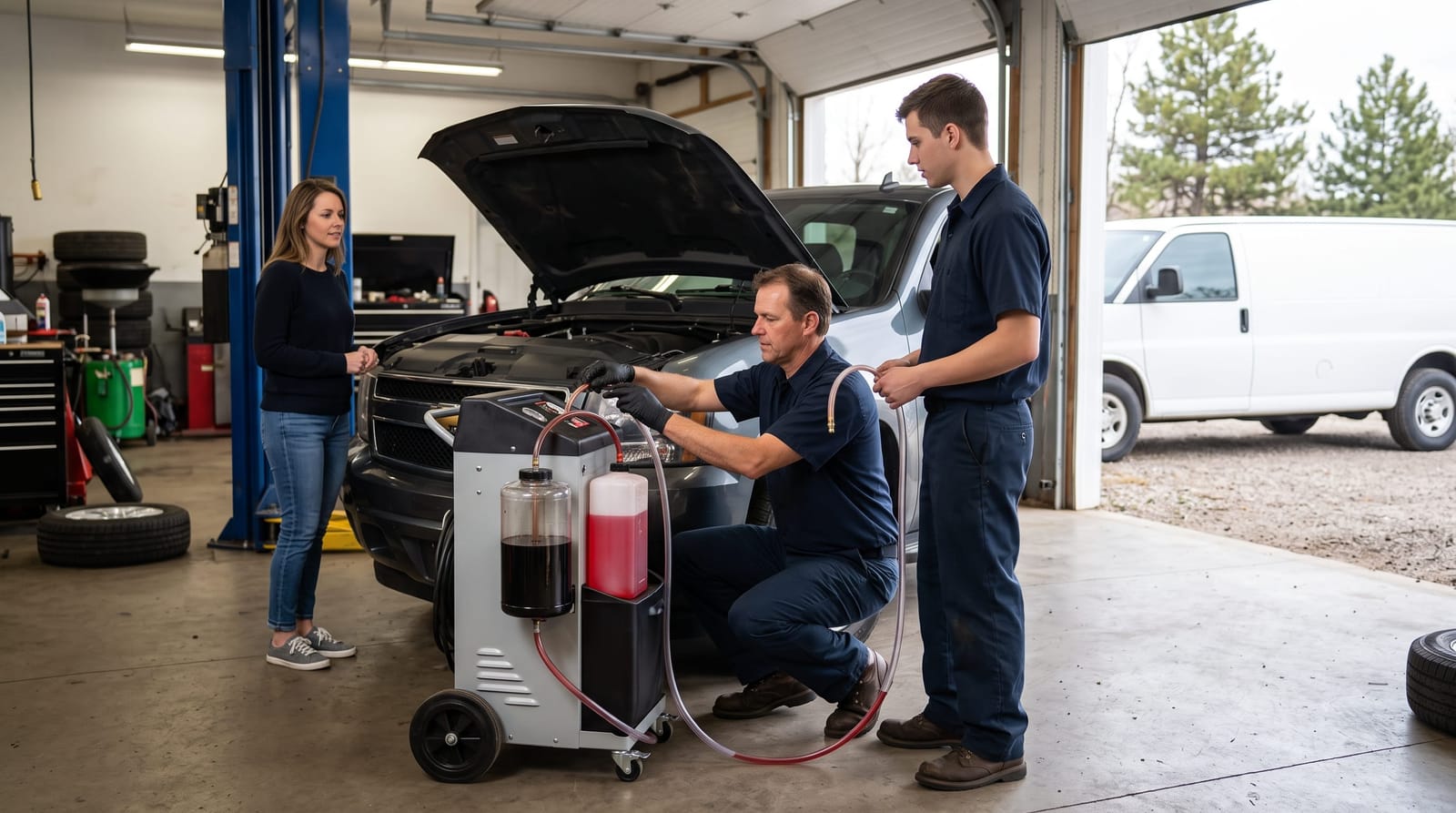
When Colorado drivers think about routine maintenance, oil changes and tire rotations usually top the list. Transmission fluid service rarely gets the same attention, and that oversight is quietly destroying transmissions across Fort Lupton, Brighton, and the wider Weld County area every single day. As part of our Complete Guide to Transmission Repair & Rebuilds for Colorado Drivers, this post focuses on the single most preventable cause of premature transmission failure: neglected fluid maintenance. Whether you're driving a daily commuter, a diesel work truck, or a vehicle that regularly hauls loads through Colorado's demanding terrain, understanding transmission fluid, what it does, how it degrades, and how to service it correctly, can save you thousands of dollars and years of reliable driving. Here are the best practices every vehicle owner should know.
Best Practice #1: Understand What Transmission Fluid Actually Does
Transmission fluid is easy to take for granted because you never really see it working. But inside your transmission, it's doing several critical jobs simultaneously, and none of them are optional.
The Four Primary Functions of Transmission Fluid
- Lubrication: The transmission contains dozens of moving metal components, gears, clutch packs, bands, and bearings, all spinning at high speed. Fluid creates a protective film between these surfaces, preventing direct metal-to-metal contact that would otherwise cause rapid wear.
- Hydraulic pressure: In automatic transmissions, fluid is the medium through which the transmission's control system actually shifts gears. Without proper fluid pressure, shifts become sluggish, harsh, or stop happening altogether.
- Heat dissipation: Transmissions generate significant heat, especially under load. Fluid absorbs and transfers that heat away from critical components. Once fluid degrades, its ability to manage heat drops sharply.
- Cleaning and conditioning: Modern transmission fluids contain detergent additives that keep internal components clean and seals pliable. As these additives break down, varnish and sludge begin to accumulate inside the unit.
The important takeaway here is that transmission fluid is not passive: it's actively protecting your transmission every time you drive. When it degrades, all four of these functions are compromised at once.
Best Practice #2: Know the Signs of Degraded Transmission Fluid
Fresh automatic transmission fluid is typically bright red and nearly transparent. If you pull your transmission dipstick (on vehicles equipped with one) and the fluid looks brown, smells burnt, or feels gritty between your fingers, the fluid has already crossed into dangerous territory. For many drivers, the first sign of fluid trouble isn't something they see: it's something they feel.
Warning Signs That Your Fluid Needs Attention
- Delayed or hesitant engagement when shifting from Park to Drive or Reverse
- Rough, jerky, or "clunking" shifts between gears
- Slipping: the engine revs up but the vehicle doesn't accelerate proportionally
- Transmission running hotter than normal, especially when towing or on grades
- Dark, burnt-smelling fluid on the dipstick or evidence of a transmission fluid leak repair Fort Lupton CO
By the time you're experiencing these symptoms, the fluid has likely been degraded for thousands of miles. The good news is that catching it at the symptom stage, before internal components are damaged, means a fluid service can often restore normal operation. Wait longer, and you may be looking at a much more involved repair. If you're already noticing shift quality issues, it's worth reading up on automatic transmission repair in Fort Lupton to understand what's happening inside the unit.
Best Practice #3: Understand the Difference Between a Drain-and-Fill and a Full Flush
This is where a lot of confusion, and some bad advice, lives. "Transmission fluid service" can mean two very different things, and choosing the right one for your situation matters.
Drain-and-Fill
A drain-and-fill (also called a partial fluid exchange) removes the fluid that drains out when the pan is dropped: typically 30% to 50% of the total fluid volume. The rest stays in the torque converter and cooler lines. This approach is gentler, allows for pan inspection and filter replacement, and is generally the preferred service for vehicles that are already on a regular maintenance schedule. In Fort Lupton and surrounding areas, a transmission drain-and-fill service typically runs in the $150-$175 range.
Full Flush
A full flush uses specialized equipment to push fresh fluid through the entire system, replacing nearly 100% of the old fluid, including what's trapped in the torque converter. This is more thorough and makes sense for vehicles that are overdue for service or operating in severe-duty conditions. A full flush in the Fort Lupton area generally runs $165-$290 depending on vehicle type and fluid specification. Note that a flush on a transmission with very high mileage and long-neglected fluid requires careful professional judgment: dislodging heavy deposits in a worn transmission can occasionally accelerate problems rather than fix them. This is a conversation worth having with a qualified technician before proceeding.
Best Practice #4: Follow Service Intervals That Reflect How You Actually Drive
Manufacturer maintenance schedules are a starting point, not a universal answer. Those intervals are typically written for "normal" driving conditions, but most Colorado drivers, particularly those in Weld County and the northern Denver Metro, don't drive in normal conditions.
General Interval Guidelines by Vehicle Type
- Passenger cars and light trucks (non-towing): Most manufacturers suggest fluid service somewhere between 30,000 and 60,000 miles for automatic transmissions, though some specify longer intervals with certain synthetic fluids. Consult your owner's manual and ask your service shop about the specific fluid in your vehicle.
- Trucks and SUVs used for regular towing or hauling: Severe-duty conditions shorten intervals significantly. Many transmission specialists recommend servicing every 15,000 to 30,000 miles for vehicles regularly under load.
- Manual transmissions: Manual gearbox fluid is often overlooked because it doesn't have the same "automatic" connotations, but it degrades too. If you're navigating manual transmission and clutch repair in Weld County, fluid condition is one of the first things a technician should evaluate.
The key principle: if you tow, haul, drive in stop-and-go traffic frequently, or spend time on mountain roads, you are operating in severe-duty conditions regardless of what your odometer says.
Best Practice #5: Apply Specific Discipline for Diesel Trucks in Colorado Conditions
Diesel truck owners in Fort Lupton and Weld County face a set of transmission demands that simply don't apply to the average passenger car driver. This deserves its own section because the consequences of neglect are proportionally larger.
Why Diesel Trucks Are Harder on Transmission Fluid
Modern diesel trucks, Ram 2500s and 3500s, Ford Super Duty F-250s and F-350s, Chevy and GMC HD trucks, produce enormous torque figures. That torque is transmitted through the drivetrain every time you accelerate, and it generates heat. Add a loaded trailer, a long mountain grade on I-25 or US-34, or agricultural hauling on county roads, and you have a recipe for fluid that degrades faster than the calendar would suggest.
Colorado's mountain driving compounds this. Descending a grade in tow mode forces the transmission to hold lower gears for engine braking, which keeps fluid temperatures elevated for extended periods. Heat is the single greatest enemy of transmission fluid longevity: every 20-degree increase in sustained operating temperature can roughly cut fluid service life in half.
Recommended Approach for Diesel Truck Owners
- Track fluid condition by miles and by operating conditions: a truck that tows 15,000 miles is not the same as one that drives 15,000 highway miles unloaded.
- Consider a transmission temperature gauge or monitor if your truck doesn't have one: it gives you real data about how hard your transmission is working.
- Use the correct fluid specification for your specific transmission: using the wrong fluid type can void warranties and cause shift quality issues even when the fluid is fresh.
- For a deeper dive into diesel-specific intervals, see our detailed breakdown of how often you should change transmission fluid in a diesel truck.
Best Practice #6: Choose a Transmission Specialist Over a General Quick-Lube Shop
Transmission fluid service looks simple on the surface, drain old fluid, add new fluid, but the details matter in ways that a general quick-lube operation may not address.
What a Qualified Transmission Shop Does Differently
- Correct fluid identification: Modern vehicles use a wide range of fluid specifications: ATF+4, Dexron VI, Mercon LV, Ford-specific fluids, and more. Using the wrong type can cause shift quality problems and accelerated wear even when the fluid itself is clean.
- Pan inspection: When the pan is dropped for a drain-and-fill, a trained technician looks at what's in the pan. Fine metal particles in small amounts are normal wear; large metal flakes, chunks, or heavy sludge are warning signs of internal damage that a fluid change alone won't fix.
- Filter replacement: Many automatic transmissions have an internal filter that should be replaced at service intervals. This step is sometimes skipped at non-specialist shops.
- Leak detection: A specialist will spot pan gasket seepage, line fitting leaks, or cooler issues during service: small problems that are far cheaper to address now than after they've progressed. Any active leak, no matter how minor, warrants immediate attention.
At Colorado Transmission & Diesel Specialists in Fort Lupton, transmission fluid service is part of a 27-plus year focus on transmission systems specifically, not a side item between oil changes. When questions arise about whether a fluid service is sufficient or whether a more significant repair may be needed, that context matters. Understanding when a rebuild might be the better path is something our guide to transmission rebuild vs. replacement in Colorado covers in detail.
Related Details Worth Exploring
If you want to go deeper on specific aspects of transmission fluid service, two related topics are worth your time:
- If you drive a diesel truck and want precise interval guidance based on your specific application and operating conditions, our post on how often to change transmission fluid in a diesel truck walks through the variables in detail.
- If you've noticed spots on your driveway or are losing fluid between service intervals, our post on transmission fluid leak causes and repair in Fort Lupton explains what's likely happening and what the fix looks like.
The Bottom Line on Transmission Fluid Service
Transmission fluid service is not glamorous maintenance. It doesn't come with a reminder sticker on your windshield. It's easy to defer, until it isn't. The transmission in your vehicle is one of the most expensive components to repair or replace, and degraded fluid is the leading preventable cause of premature failure. For most drivers in Fort Lupton and Weld County, the math is straightforward: a fluid service in the $150-$290 range, done on a schedule that reflects how you actually use your vehicle, protects an investment that could cost $3,000 to $8,000 or more to repair or rebuild if neglected.
If you're not sure when your transmission fluid was last serviced, or if it's ever been serviced, that's your answer. Contact Colorado Transmission & Diesel Specialists in Fort Lupton to schedule a fluid inspection. We'll check the condition, identify the correct fluid specification for your vehicle, and give you an honest recommendation on what service makes sense for your situation.